Kubri Engineered Solutions (KES) | DIAMANT Polymer Solutions

Liquid Shim for Offshore,
Marine, and Heavy Port Equipment

Corrosion-resistant, full-surface load transfer for lock gates and marine steel connections.
Fatigue-tested to 10 million load cycles at ibac RWTH Aachen.

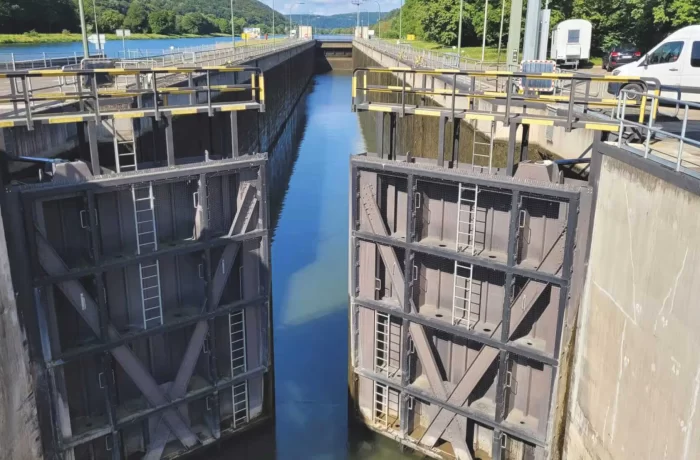
Lock gates, stackers, and marine steel connections face two demands that most gap-compensation methods aren’t built to meet simultaneously: constant saltwater exposure and constant cycling loads.

DIAMANT MM1018 closes the gap as a single bonded, corrosion-resistant layer, fatigue-tested to 10 million load cycles.

Kubri Engineered Solutions is the Australian technical partner for DIAMANT Polymer GmbH, supplying and specifying MM1018 for lock gates, crane runways, stackers and reclaimers, and marine and offshore steel connections across Australian ports and waterways.

Marine and Port Connections Carry Cyclic Load in a Corrosive Environment

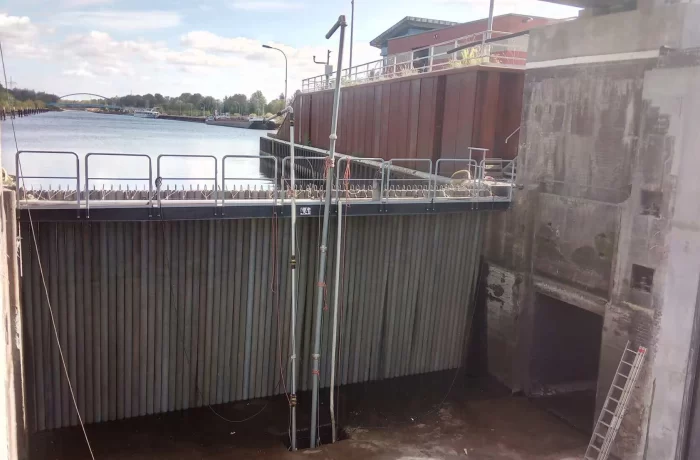
Steel-to-steel and steel-to-concrete interfaces in marine and port environments carry two compounding risks: corrosion and cyclic load. A gap that traps moisture, such as a lining plate behind a lock gate’s stem cleat, creates the confined microenvironment where crevice corrosion starts, and chloride exposure accelerates it. The mechanical joint meant to close the gap becomes the part most likely to fail first.

These interfaces are also rarely still: lock gates cycle open and closed for the asset’s life, and crane runways and stacker rails take a wheel pass on every cycle. The connection is designed to spread that load evenly across the full contact surface. When a lining plate or grout bed only touches at a few high points instead of the whole surface, the load concentrates there instead, carrying more stress than the connection was built for on every cycle, which is how a fatigue crack starts.

Engineers have traditionally closed these gaps with individually machined lining plates or wedge blocks. It is a known method, but one that takes several days to fit on site and still leaves the mechanical joint and its crevice in place. On a lock, dry dock, or port facility, that timeline is the harder constraint. These assets can’t go offline for days without stopping shipping traffic or cargo handling, so the closure window is often just hours, a schedule that multi-day machining can’t meet.

A Full-Contact, Corrosion-Resistant Interface
Installed in a Single Sealed Pour

By bonding into the gap as a single sealed layer, MM1018 removes the crevice that corrosion needs to start, restores the full-surface contact the connection needs to carry cyclic load without concentrating stress at isolated points, and cures fast enough to fit inside a lock, dry dock, or port shutdown window.

MM1018 FL or P is poured, injected, or trowelled into the sealed gap at the marine or port steel interface. It flows into or is applied across the space present on site and cures into a rigid, dimensionally stable layer that restores full-surface, force-fit and form-fit contact, in a four-step sequence carried out on site:

01

Seal

The gap perimeter is sealed with MM1018 Seal, pressed into a minimum depth of 10mm to form a leak-proof barrier, then left to cure before injection begins.

02

Inject

MM1018 FL is poured or injected from the lowest point of the gap, or MM1018 P is applied by trowel on vertical or overhead surfaces such as a lock gate face or ship hull connection, with injection and ventilation points planned so trapped air is displaced ahead of the material.

03

Cure

The material cures with negligible shrinkage (0.035%) and reaches ≥97% of design strength at 24 hours (+21°C) with full design strength at 7 days. Service load is not to be applied before strength is verified.

04

Verify

Sample sets are taken during the pour and checked for Shore D hardness and cure consistency before the connection is loaded and the structure returns to service.

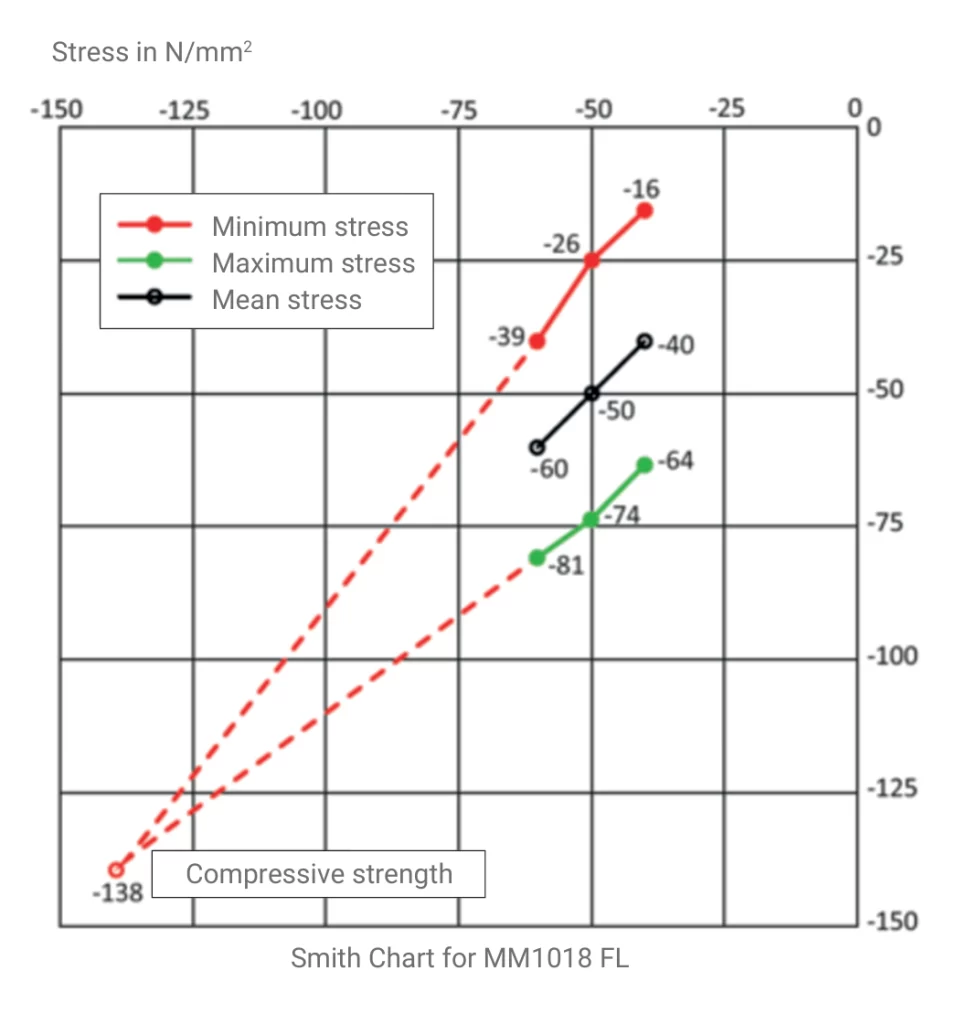
MM1018_Smith_Chart_Page4_EXACT

DIAMANT MM1018 Fatigue
and Corrosion Performance

10,000,000 load cycles
(ibac, RWTH Aachen - test M1999)

Lock gates and stacker baseplates experience continuous wheel and vibration loads and millions of significant load events over their service life. The credential that speaks to that kind of load case is third-party fatigue testing.

MM1018 FL has been fatigue-tested to 10 million load cycles and has passed. Testing was carried out independently by ibac at RWTH Aachen (test M1999) at mean stresses of 40, 50, and 60 N/mm²; all three test series completed the full 10 million cycles with no loss of structural integrity. For context, EN 1993-1-9 sets the constant-amplitude fatigue limit for structural steel at 5 million cycles.

DIAMANT’s MM1018 FL is corrosion- and weathering-resistant, seawater-resistant, and stainless. Because the compound is bonded into the gap as a single sealed layer, it also removes the confined, moisture-trapping crevice behind a lining plate or shim stack that corrosion depends on.

MM1018 FL holds German general building authority approval (abZ Z-3.82-2042) from DIBt. It achieves a compressive strength of 161 N/mm² under DIN EN 12190:1998.

MM1018 FL technical data
for Marine and Port Applications

Property Value
Fatigue strength 10,000,000 load cycles at mean stresses of 40, 50, and 60 N/mm² (ibac RWTH Aachen, test M1999). No loss of structural integrity recorded
Compressive strength
(fully cured)
161 N/mm² (DIN EN 12190:1998)
Shrinkage 0.035% (DIN EN 12617-4:2002)
Curing time to full load capacity 97% or more of design strength at 24 hours (+21°C); full design strength at 7 days. Service load not to be applied before strength is verified.
Curing at other temperatures Min. curing temperature +5°C; accelerated curing permitted to a maximum of 50°C. Strength development varies with temperature. Refer to DIAMANT TDS #1866 V1.1 for values by temperature and age.
Corrosion/weathering resistance Resistant to corrosion and weathering; seawater-resistant, stainless
Maximum layer thickness (manufacturer-tested) Up to 140 mm
Maximum layer thickness (abZ-approved) Up to 10 mm per layer
Service temperature
(per abZ)
-20°C to +50°C
Product variants for this application MM1018 FL (poured/injected, horizontal flange gaps) and MM1018 P (trowel-applied, vertical or overhead flange faces)
Key accessories MM1018 Seal (perimeter sealing), injection/ventilation packers, DIAMANT cleaner, screw protection where applicable

Compressive strength, fatigue certification, and cure time figures for MM1018 are sourced from the official DIAMANT Technical Datasheet (#1866, Version 1.1, dated 14 July 2026). KES can map this data against project-specific specifications on request, including AS 4997 for near-shore and port structures.

For a full technical overview of liquid shim technology and applications,
visit the Liquid Shim in Australia Resource Centre.

For crane and stacker rail interfaces specifically, see Liquid Shim for Crane Runway Rails.

For rotating equipment such as pumps and generators on port and marine sites,
see Liquid Shim for Equipment Foundations.

The Australian
technical authority
for liquid shim

engshokry

Kubri Engineered Solutions is Australia’s dedicated technical authority for liquid shim technology and the Australian partner for DIAMANT Polymer GmbH, manufacturer of MM1018 The Liquid-Shim®.

KES supports every specification with a complete engineering support package:

Design Support:

Engineering review of the lock gate, crane runway, or marine steel interface during the design phase, before fabrication or installation.

Installation Methodology:

Project-specific method statements, ITP hold points, and on-site attendance for first-of-type marine and port installations, planned around lock, dry dock, or shutdown closure windows.

Interface Control:

Product selection across the MM1018 family (FL, P, Smart S, Seal) matched to gap geometry, access, and project constraints.

Documentation:

Material certification, batch traceability, abZ approval documentation, and installation records formatted for ITP, handover, and the asset register.

Founded by Loai Shokry, a Chartered Professional Engineer (CPEng) with a career spanning the design and delivery of multi-billion-dollar infrastructure projects in Australia and worldwide, Kubri Engineered Solutions operates as a specification and engineering partner across the full project lifecycle, from design review to handover documentation.

Have an Offshore or Port Equipment Project?

Send the interface details, and a KES engineer will respond within one business day with product selection and the next steps on installation methodology.

Final product selection and specification remain subject to engineer-of-record approval for your project.

    Frequently asked questions

    Machining and fitting lining plates on site typically takes several days, and the resulting mechanical joint stays vulnerable to loosening and crevice corrosion. Pouring or injecting MM1018 into the sealed gap creates a single bonded layer upon curing, eliminating both the fitting time and the mechanical joint.

    DIAMANT recommends grid-blasting to a roughness of 50-60 µm (SA2.5) where practical, and cleaning the surface free of oil, corrosion products, and dust with DIAMANT cleaner or equivalent beforehand.

    Yes. MM1018 is engineered for steel-to-steel and steel-to-concrete joints alike, so it suits a steel lock gate cleat bonded to surrounding masonry, a crane rail seated on a concrete or steel support, or a stacker baseplate on a concrete plinth, all within the same product family.