
Liquid Shim vs. Steel Shim Plates
A Structural Engineer's Comparison
Both belong to the epoxy chemistry family,
but they are built for different jobs.
Epoxy grout is a proven choice for bedding baseplates onto concrete foundations under standard rotating and reciprocating equipment.
MM1018 The Liquid-Shim® is also an epoxy-family polymer. But it is engineered specifically for precision gap compensation under fatigue load, in preloaded and force-fit connections where dimensional stability, not bulk fill, is the governing requirement.
Kubri Engineered Solutions supplies MM1018 and provides the engineering support to specify and install it correctly for the applications where a general-purpose epoxy grout reaches its design limits.
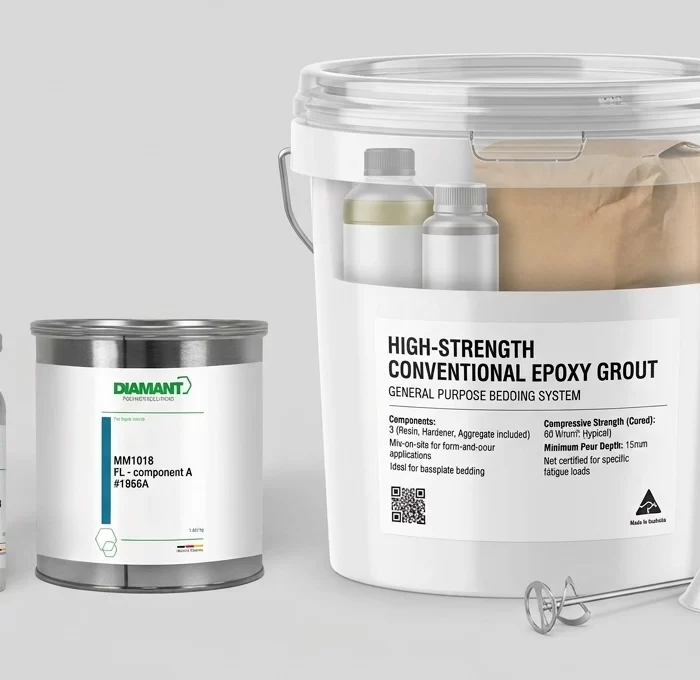
Technical Data
MM1018 Liquid Shim vs. Epoxy Grout
The table below compares the verified technical properties of DIAMANT MM1018 against the general performance parameters of conventional machinery epoxy grouts.
| Property | MM1018 Liquid Shim (FL) | Conventional Epoxy Grout |
|---|---|---|
| Product category | Precision gap compensation polymer, built for preloaded and force-fit metal-to-metal connections | General-purpose grout for bedding equipment baseplates to a concrete foundation |
| Compressive strength | 161 N/mm² (DIN EN 12190:1998) | Typically 60-100 N/mm² depending on product and cure stage |
| Fatigue certification | 10M cycles (ibac RWTH Aachen, M1999) | No equivalent published third-party fatigue certification identified in standard manufacturer datasheets |
| Gap range | Up to 10 mm per layer (abZ-approved); up to 140 mm manufacturer-tested via multiple layers. | Typically 15-200 mm depending on product; most manufacturers specify a minimum pour depth (commonly 15-25 mm) |
| Flow characteristics | Low-clearance, self-leveling flow engineered for injection into narrow, sealed cavities; viscosity 16,900 mPas | Higher-viscosity, aggregate-filled pour or pump-grade consistency, designed for form-and-pour placement |
| Cure time to full load | 97% or more of design strength at 24 hours (+21°C); full design strength at 7 days. Service load not to be applied before strength is verified. | Typically 24 hours to reach initial handling strength; several manufacturers specify post-curing (16-24 hours at 60°C) to reach maximum published strength |
| Pot life / working time | 89 minutes ±20% at 20°C (1 kg pack, DIN EN ISO 9514) | Typically 60-90 minutes depending on product, batch size, and ambient temperature |
| Service temperature | -20°C to +50°C per abZ approval; temperature resistance up to 160°C material property | Typically up to 60-95°C continuous service depending on product; some high-temperature variants rated higher |
Compressive strength, fatigue certification, gap range, flow characteristics, cure time, and pot life figures for MM1018 are sourced from the official DIAMANT Technical Datasheet (#1866, Version 1.1, dated 14 July 2026). KES can map this data against project-specific design specifications on request.
Epoxy grout figures are sourced from published manufacturer datasheets for MasterFlow 648 (Master Builders Solutions), Five Star DP Epoxy Grout, and the SikaFlow epoxy grout range.
Fatigue Certification
Epoxy grout is the default for rotating and reciprocating machinery: bedding a baseplate to a concrete foundation and transferring static to moderate dynamic loads.
That changes in applications where cyclic load is the governing design case: wind turbine tower flanges, bridge bearings under live traffic, crane runway rails, and bolted joints under repeated shear. In these cases, the material is not only bedding equipment to a foundation; it is transferring a repeated, high-magnitude load through a metal-to-metal interface for the design life of the structure.
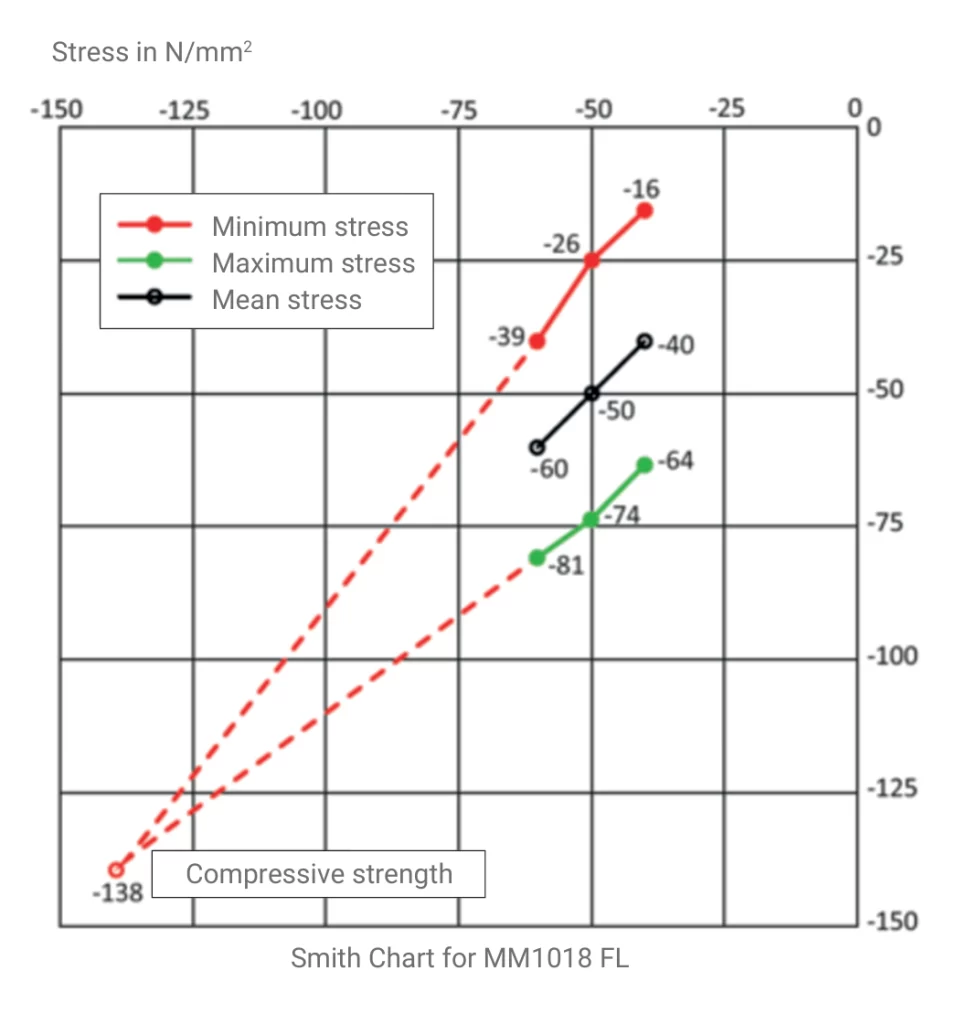
MM1018 FL was subjected to independent fatigue testing by ibac (Institut für Bauforschung) at RWTH Aachen University, sustaining 10 million load cycles at mean stresses of 40, 50, and 60 N/mm², with no loss of structural integrity. For context, EN 1993-1-9 sets the constant-amplitude fatigue limit for structural steel at 5 million cycles.
KES has not identified any conventional epoxy grout with an equivalent published third-party fatigue certification at this duration. For structural engineers who require a documented basis for a fatigue-critical dynamic load application, MM1018 is the only material in this category that provides one.
Application guide
When to Specify Which
Standard Scenarios for Conventional Epoxy Grout
Well-engineered epoxy grout is the correct, proven specification for:
- Standard rotating and reciprocating machinery: Pumps, motors, and compressors under static or moderate dynamic load.
- Large-volume machinery baseplate pours: Straightforward installations where bulk form-and-pour placement with aggregate fill is more practical than injection.
- High continuous service temperatures: environments where continuous exposure exceeds MM1018's +50°C service temperature limit.
High-Demand Scenarios for MM1018 Liquid Shim
MM1018 is specified over conventional epoxy grout in the following cases:
- Heavy Rotating Equipment Under Sustained Vibration: Crushers, mills, turbines, and compressors generating fatigue-critical vibration. See liquid shim for equipment foundations.
- Wind Turbine Tower Flange Connections: Cyclic wind and rotor loading make fatigue the governing design case at the tower flange interface. See liquid shim for wind turbine applications.
- Bridge Bearings Under Live Traffic: MM1018 provides full-surface contact and a documented fatigue record matched to long bridge design lives. See liquid shim for bridge bearings.
- Crane Runway Rails: MM1018 prevents the rail seat degradation commonly seen with conventional grout systems. See liquid shim for crane runway rails.
- Bolted Joints Under Repeated Shear: Preloaded connections subject to cyclic shear benefit from MM1018's dimensional stability and abZ approval for preloaded connections. See liquid shim for bolted joints.
Frequently Asked Questions
Conventional epoxy grout is formulated for form-and-pour placement, mixed with aggregate filler and poured or pumped into a formed cavity. MM1018 is a highly-filled metal polymer formulated for injection into a sealed metal-to-metal gap, engineered for dimensional stability and fatigue performance under cyclic load.
MM1018 FL can be poured into an open cavity for gap closure. For precision baseplates and structural connections, it is injected into a sealed cavity using dedicated injection packers and MM1018 SEAL for circumferential sealing.
No. MM1018 is supplied as a highly-filled two-component polymer, mixed at the stated resin-to-hardener ratio and used as delivered, without a separate aggregate-addition step.
No. MM1018 FL reaches 97% or more of design strength at 24 hours (+21°C) and full design strength at 7 days through ambient cure. Its cure can be accelerated with heat if needed, up to a maximum permissible temperature of 50°C; this is optional, not required.

Engineering Authority,
Australian Support.
Specifying MM1018 in place of a conventional epoxy grout changes the installation methodology, the sealing requirements, and the documentation. Getting these details wrong shifts risk from the grout bed to the project record.
Helping you manage that risk is Kubri Engineered Solutions, Australia’s dedicated technical authority for liquid shim technology.
Kubri Engineered Solutions is the Australian partner for DIAMANT Polymer GmbH, manufacturer of MM1018 The Liquid-Shim®, and holds exclusive technical partnerships with globally recognised manufacturers, including Maurer (expansion joints, structural bearings), Panacor (noise barriers, fire protection walls), and EarthTec (reinforced retaining walls).
KES supports your specification by supplying a complete engineering support package:
Design Support:
Interface review and product-variant selection (FL, P, or Smart S) matched to the gap geometry.
Installation Methodology:
Preparation of method statements covering sealing, injection layout, and QA checkpoints.
Interface Control:
Specification of the complete system, including MM1018 SEAL and dedicated injection hardware.
Documentation:
Provision of material certification, batch traceability, and abZ approval documentation formatted for ITPs and asset registers.
Founded by Loai Shokry, a Chartered Professional Engineer (CPEng) with a career spanning the design and delivery of multi-billion-dollar infrastructure projects in Australia and worldwide, Kubri Engineered Solutions is a specification and engineering partner, not just a product distributor.
For a full technical overview of liquid shim technology and applications,
visit the Liquid Shim Australia resource centre.
Talk to a KES engineer
Send us your connection details. A KES engineer will respond within one business day with the correct product selection and the next steps on installation methodology. Final product selection and specification remain subject to engineer-of-record approval for your project.