
Liquid Shim vs. Dry-Pack Mortar
A Structural Engineer's Comparison
Dry-pack mortar is widely used in structural baseplate work. It is a low-slump cementitious mix, hand-compacted into the gap beneath a baseplate in thin layers using a tamping rod and hammer. It is also recognised in guidance such as ACI 351.1R* for confined spaces where a flowable grout can’t be used.
The trade-off is that dry-pack’s installed performance depends almost entirely on the compaction technique of the person placing it: layer thickness, tamping force, and coverage must be applied consistently, and there is no reliable way to verify the result once the baseplate is set.
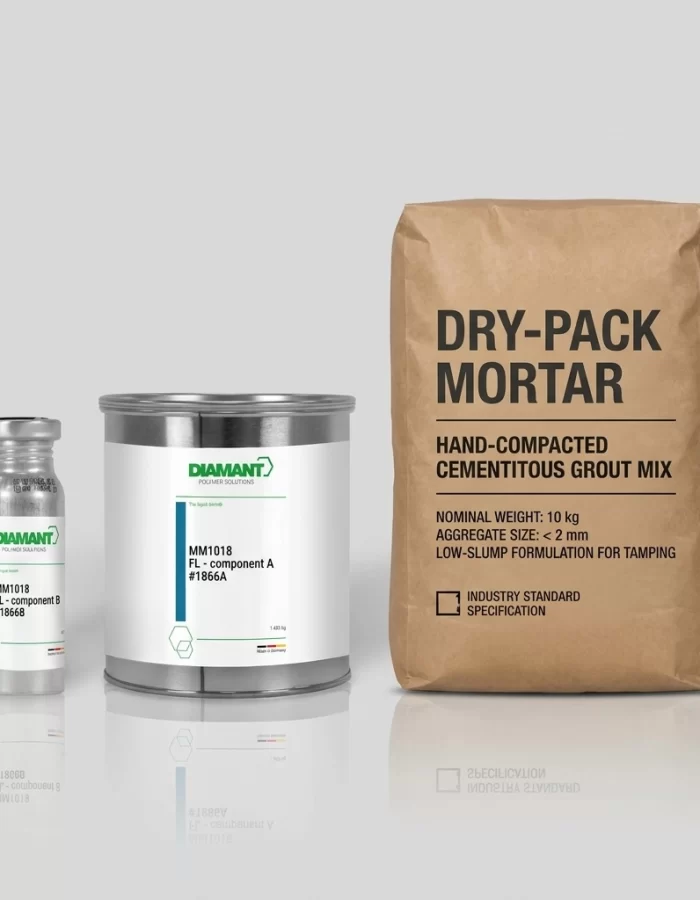
DIAMANT MM1018 Liquid Shim replaces that manual, technique-dependent process with a poured or injected system. Kubri Engineered Solutions supplies MM1018 and the engineering support to specify and install it correctly.
*American Concrete Institute; a US reference, cited in the absence of an equivalent Australian Standard
Technical Data
MM1018 Liquid Shim vs. Dry-Pack Mortar
The table below compares the verified technical properties of DIAMANT MM1018 against the general characteristics of dry-pack mortar as described in ACI 351.1R grouting guidance.
| Property | MM1018 Liquid Shim (FL) | Dry-Pack Mortar |
|---|---|---|
| Placement method | Poured or injected into a sealed cavity; flows into place under gravity or injection pressure | Hand-compacted in thin layers (approximately 13 mm) using a tamping rod and hammer, driven systematically across the entire surface |
| Load performance / void risk | 100% void fill; cures bonded to both surfaces | ACI 351.1R limits dry-pack to confined spaces under about 460 mm in any direction specifically because larger areas can't be reliably compacted by hand |
| Compressive strength | 161 N/mm² (DIN EN 12190:1998) | Typically 40-55 MPa at 28 days for properly proportioned dry-pack, per ACI 351.1R |
| Cure time to full load | 97% or more of design strength at 24 hours (+21°C); full design strength at 7 days. Service load not to be applied before strength is verified. | ACI 351.1R recommends moist curing for at least 7 days, or a shorter moist period followed immediately by a curing compound |
| Program dependency | A defined mixing, injection, and cure procedure; installation time doesn't scale with baseplate size the way manual compaction does | Requires an experienced crew on site for labour-intensive hand compaction; both installation time and quality scale with the area to be packed |
| Shrinkage | 0.035% (DIN EN 12617-4:2002) | Cementitious dry-pack is subject to drying shrinkage (assessed under AS 1478.2 test protocols); ACI 351.1R requires wet curing or a curing compound specifically to control shrinkage cracking during cure |
| Gap/area suitability | Up to 10 mm per layer (abZ-approved); up to 140 mm manufacturer-tested via multiple layers. | Best suited to small, confined areas; ACI 351.1R limits dry-pack width in any direction to approximately 460 mm to allow proper hand compaction |
| Structural approval | abZ Z-3.82-2042, DIBt (Germany): general building authority approval covering use in preloaded structural connections | Governed by ACI 351.1R grouting guidance and individual product compliance, not a general building authority structural approval |
Compressive strength, shrinkage, fatigue certification, cure time, and gap/area suitability figures for MM1018 are sourced from the official DIAMANT Technical Datasheet (#1866, Version 1.1, dated 14 July 2026). KES can map this data against project-specific design specifications on request.
Fatigue certification
Undetected Voids Become a Bigger Problem Under Cyclic Load
Dry-pack’s dependence on hand compaction is a known, managed risk in static applications. ACI 351.1R mitigates it with layer-by-layer inspection during placement, but checking the result afterward is harder: sounding the surface with a steel rod is the standard method, and ACI notes it doesn’t reliably detect small voids. Some engineers don’t consider it dependable at all, and confirming compaction quality with real confidence can require dismantling the installation.
Under a static load case, an undetected void is usually tolerable. Under a cyclic load case, a wind turbine flange, a bridge bearing under live traffic, a crane runway rail, or rotating equipment under sustained vibration, that same void becomes a starting point for progressive deterioration under repeated loading.
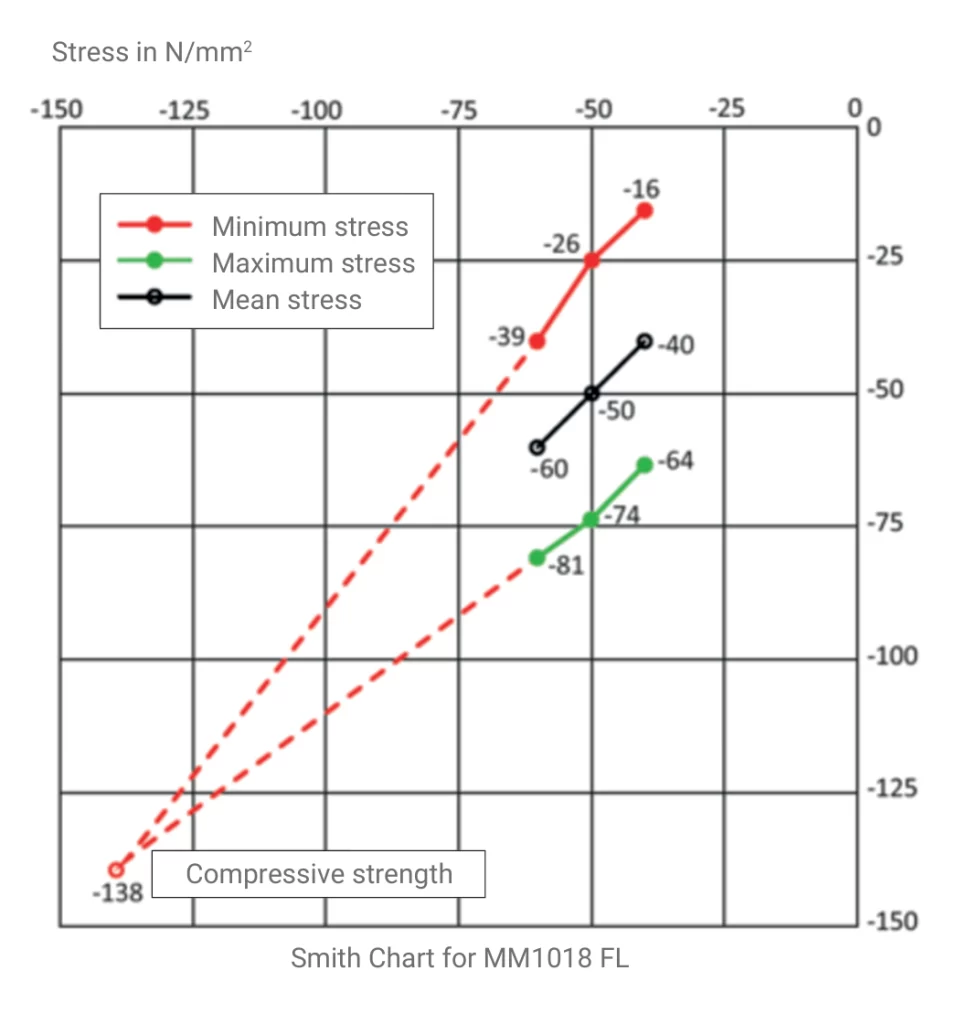
MM1018 FL removes the installation-technique variable from the load path. It was fatigue tested to 10 million load cycles and passed. Testing was carried out independently by ibac at RWTH Aachen (test M1999) at mean stresses of 40, 50, and 60 N/mm²; all three test series completed the full 10 million cycles with no loss of structural integrity. For context, EN 1993-1-9 sets the constant-amplitude fatigue limit for structural steel at 5 million cycles.
Application guide
When to Specify Which
Standard Scenarios for Dry-Pack Mortar
Dry-pack mortar is the adequate, cost-effective specification for:
- Non-critical static baseplates: Where the load case is static and the connection isn’t subject to sustained vibration or cyclic loading.
- Small, confined areas: ACI 351.1R recommends dry-pack for areas under roughly 460 mm in any direction, where hand compaction can be reliably and completely executed.
- Cost-constrained projects: Where the lower material cost of a cementitious dry-pack mix outweighs the installation-variability risk for the specific application.
High-Demand Scenarios for MM1018 Liquid Shim
MM1018 is specified over dry-pack mortar in the following cases:
- Vibration-Critical Connections: Rotating equipment and machinery foundations where cyclic loading makes installation-technique variability an unacceptable risk. See Liquid Shim for Equipment Foundations.
- High-Value or Large-Area Installations: Bridge bearings, crane runway rails, and wind turbine tower flanges, where the baseplate exceeds what ACI 351.1R considers suitable for reliable hand compaction. See Liquid Shim for Bridge Bearings and Liquid Shim for Crane Runway Rails.
- Structural Steel in Seismic or Wind-Dynamic Zones: Column baseplates subject to repeated lateral or uplift cycling benefit from a bonded, fatigue-certified load path instead of a hand-compacted one. See Liquid Shim for Structural Steel Baseplates.
Frequently Asked Questions
Dry-pack mortar uses far less water than a flowable or pumpable grout. Because it has essentially zero slump, it can’t flow into place under gravity and must instead be compacted using a tamping rod and hammer. Pumped or poured cementitious grout, by contrast, flows into place under its own weight or pump pressure through a headbox.
ACI 351.1R limits dry-pack placement to areas of roughly 460 mm or less because the technique depends on hand compaction reaching every part of the gap. Above that size, it becomes difficult to compact the mortar consistently across the full area, which increases the risk of incomplete compaction and voids beneath the baseplate.
The standard method is sounding: tapping the surface with a steel rod and listening for a hollow sound (indicating a void) versus a ringing sound (indicating tight contact).
ACI 351.1R notes this method doesn’t reliably detect small voids, and some engineers don’t consider it dependable at all. Verifying compaction quality with real confidence requires dismantling and inspecting the installation directly, which isn’t practical for most in-service connections.
Yes. ACI 351.1R recommends moist curing for at least 7 days, or a shorter moist period followed immediately by a curing compound, to prevent drying shrinkage and cracking. MM1018 doesn’t have an equivalent requirement: it cures through a two-component chemical reaction, so no moisture curing is needed.

Engineering Authority,
Australian Support.
Moving from dry-pack mortar to MM1018 changes how the baseplate connection is prepared, sealed, and injected, and what documentation is available to demonstrate the installation was completed correctly. Getting these details right removes the installation-technique risk that dry-pack inherently carries.
Helping you manage that transition is Kubri Engineered Solutions, Australia’s dedicated technical authority for liquid shim technology.
Kubri Engineered Solutions is the Australian partner for DIAMANT Polymer GmbH, manufacturer of MM1018 The Liquid-Shim®, and holds exclusive technical partnerships with globally recognised manufacturers, including Maurer (expansion joints, structural bearings), Panacor (noise barriers, fire protection walls), and EarthTec (reinforced retaining walls).
KES supports your specification by supplying a complete engineering support package:
Design Support:
Interface review and product-variant selection (FL, P, or Smart S) matched to the gap geometry.
Installation Methodology:
Preparation of method statements covering sealing, injection layout, and QA checkpoints.
Interface Control:
Specification of the complete system, including MM1018 SEAL and dedicated injection hardware.
Documentation:
Provision of material certification, batch traceability, and abZ approval documentation formatted for ITPs and asset registers.
Founded by Loai Shokry, a Chartered Professional Engineer (CPEng) with a career spanning the design and delivery of multi-billion-dollar infrastructure projects in Australia and worldwide, Kubri Engineered Solutions is a specification and engineering partner, not just a product distributor.
For a full technical overview of liquid shim technology and applications,
visit the Liquid Shim Australia resource centre.
Talk to a KES engineer
Send us your connection details. A KES engineer will respond within one business day with the correct product selection and the next steps on installation methodology. Final product selection and specification remain subject to engineer-of-record approval for your project.