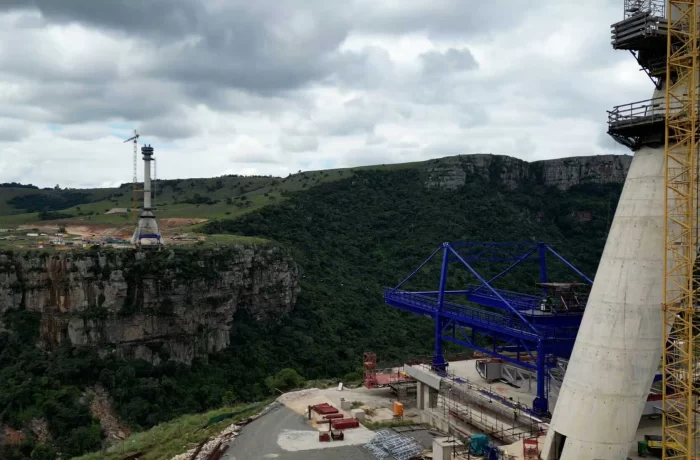
Eastern Cape, South Africa
Msikaba Bridge
Base plate deformation caused by welding-induced thermal stress during anchor block assembly on a major cable-stayed bridge, corrected with MM1018 to restore a full-surface connection to the bearing plate.

Full-surface load transfer beneath column baseplates.
Zero shrinkage, fatigue-tested to 10 million load cycles at ibac RWTH Aachen.
A column baseplate is detailed to bear evenly across its full footprint, but concrete settlement and steel fabrication variance mean the as-built gap is not exactly what the drawing specified. DIAMANT MM1018 fills that gap, curing with 0.035% shrinkage to form a full-contact structural layer and fatigue-tested to 10 million load cycles.
Kubri Engineered Solutions is the Australian technical partner for DIAMANT Polymer GmbH, supplying and specifying MM1018 for column baseplate connections on new structural steel and heritage retrofit projects alike.
A column baseplate is detailed on the assumption that it will bear evenly across its full footprint. In practice, that’s not quite true.
AS 4100 Clause 14.3.5.2 permits anchor bolt holes up to 6mm larger than the bolt diameter to accommodate assembly tolerance. Concrete foundations settle and cure unevenly, holding-down bolts drift within their allowed tolerance, and baseplates themselves are rarely dead flat after fabrication and transport.
The result is a gap underneath the baseplate that is not the dimension shown on the drawing. This gap is the layer the column’s compressive load path actually passes through.
Where the fill is inconsistent, incompletely filled, or shrinks after curing, the column stops bearing the way the structural calculation assumed.
MM1018 fills the grout pocket completely, replacing the void risk and point-contact unevenness of cementitious fill with a single, verified, full-surface layer.
MM1018 FL is a liquid, poured or injected into a sealed gap beneath the baseplate. It flows into the geometry of the space and cures into a rigid, dimensionally stable layer in a four-step sequence carried out on site:
01
The gap perimeter is sealed with MM1018 Seal, pressed in to a minimum depth for a leak-proof barrier, then left to cure before injection begins.
02
MM1018 FL is poured or injected from the lowest point of the gap, with injection and ventilation points planned to displace trapped air ahead of the material.
03
The material cures with negligible shrinkage (0.035%) and reaches ≥97% of design strength at 24 hours (+21°C) with full design strength at 7 days. Service load is not to be applied before strength is verified.
04
Sample sets are taken during the pour and checked for Shore D hardness and cure consistency before the bearing is loaded.
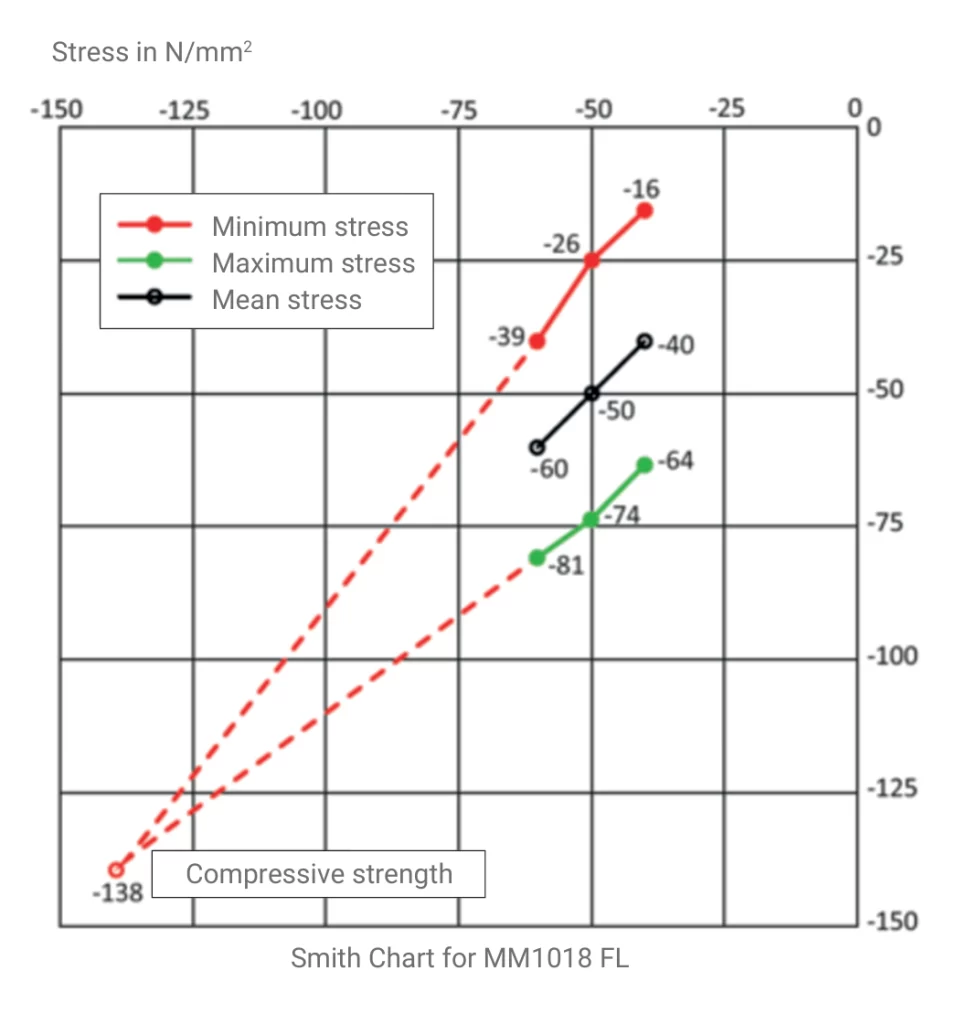
Static compressive strength is the specification parameter most commonly quoted for a grout bed. Still, it is not the only load case that a column baseplate must withstand over its service life. Structures in seismic or wind-dynamic zones, and columns supporting equipment, expose the baseplate connection to repeated lateral and uplift loading.
MM1018 FL has been fatigue-tested to 10 million load cycles and has passed. Testing was carried out independently by ibac at RWTH Aachen (test M1999) at mean stresses of 40, 50, and 60 N/mm²; all three test series completed the full 10 million cycles with no loss of structural integrity. For context, EN 1993-1-9 sets the constant-amplitude fatigue limit for structural steel at 5 million cycles.
MM1018 FL holds German general building authority approval (abZ Z-3.82-2042) from DIBt. It achieves a compressive strength of 161 N/mm² under DIN EN 12190:1998.
| Property | Value |
|---|---|
| Fatigue strength | 10,000,000 load cycles at mean stresses of 40, 50, and 60 N/mm² (ibac RWTH Aachen, test M1999). No loss of structural integrity recorded |
| Compressive strength (fully cured) |
161 N/mm² (DIN EN 12190:1998) |
| Shrinkage | 0.035% (DIN EN 12617-4:2002) |
| Curing time to full load capacity | 97% or more of design strength at 24 hours (+21°C); full design strength at 7 days. Service load not to be applied before strength is verified. |
| Curing at other temperatures | Min. curing temperature +5°C; accelerated curing permitted to a maximum of 50°C. Strength development varies with temperature. Refer to DIAMANT TDS #1866 V1.1 for values by temperature and age. |
| Maximum layer thickness (manufacturer-tested) | Up to 140 mm |
| Maximum layer thickness (abZ-approved) | Up to 10 mm per layer |
| Service temperature (per abZ) |
-20°C to +50°C |
| Viscosity | 16,900 mPas (DIN EN ISO 3219:1994) |
| Key accessories | MM1018 Seal (perimeter sealing), injection/ventilation packers, DIAMANT cleaner, screw protection where applicable |
The compressive strength, shrinkage, and fatigue figures for MM1018 are sourced from the official DIAMANT Technical Datasheet (#1866, Version 1.1, dated 14 July 2026). KES can map this data against specification requirements on request.
Eastern Cape, South Africa
Base plate deformation caused by welding-induced thermal stress during anchor block assembly on a major cable-stayed bridge, corrected with MM1018 to restore a full-surface connection to the bearing plate.

Wuppertal, Germany
Full-surface support restored on a bolted steel structure over 100 years old, without mechanical processing of the original steelwork.

Dillingen, Germany
Structural steel connection work carried out at one of Europe's major integrated steelworks facilities.

Washington, D.C., USA
Gap filling between the sole plate and the underside of the beam during installation of new elastomeric bearings on a bridge over the Potomac River.
For a full technical overview of liquid shim technology and applications,
visit the Liquid Shim Australia resource centre.


Kubri Engineered Solutions is Australia’s dedicated technical authority for liquid shim technology and the Australian partner for DIAMANT Polymer GmbH, manufacturer of MM1018 The Liquid-Shim®.
KES supports every specification with a complete engineering support package:
Design Support:
Engineering review of the baseplate interface during the design phase, before steel is fabricated.
Installation Methodology:
Project-specific method statements, ITP hold points, and on-site attendance for first-of-type baseplate installations.
Interface Control:
Product selection across the MM1018 family (FL, P, Smart S, Seal) matched to gap geometry, access, and project constraints.
Documentation:
Material certification, batch traceability, abZ approval documentation, and installation records formatted for ITP, handover, and the asset register.
Founded by Loai Shokry, a Chartered Professional Engineer (CPEng) with a career spanning the design and delivery of multi-billion-dollar infrastructure projects in Australia and worldwide, Kubri Engineered Solutions operates as a specification and engineering partner across the full project lifecycle, from design review to handover documentation.
Final product selection and specification remain subject to engineer-of-record approval for your project.
Yes, for larger baseplates. ASI Design Guide 7 (Pinned Base Plate Connections for Columns) recommends that baseplates larger than 600mm in one direction be provided with at least one grout inspection hole, typically 50 to 75mm in diameter, to confirm the fill material has risen through the full footprint during placement.
The guide notes this hole isn’t necessary where dry-pack grout is used, or for baseplates smaller than 600mm.
Yes. MM1018 FL is poured or injected into the sealed gap between the existing baseplate and the foundation surface beneath it, without requiring removal of the column or re-pour of the foundation.
MM1018 FL reaches ≥97% of design strength at 24 hours (+21°C) and full design strength at 7 days, compared with the multi-day cure period typically required for cementitious grout to reach full design strength.
Curing time for MM1018 FL can be accelerated with hot-air blowers, infrared spots, or heater blankets, up to a maximum accelerated-curing temperature of 50°C. Service load is not to be applied before strength is verified.