
MM1018 Injection Screws vs. Machined Fitted
Bolts
A structural engineer's comparison
One requires machining every hole.
The other is injected into the clearance already there.
The standard specification for a bolted connection that can’t slip under shear load is a machined-fitted bolt: a shank machined to match a hole reamed to a tight tolerance, removing the clearance gap entirely. It works, but reaming every hole on an existing structure is slow and expensive.
Injection bolts are the established alternative defined in EN 1993-1-8 and EN 1090-2: a two-component resin fills the clearance between the bolt shank and the hole wall, and the connection becomes slip-resistant once it cures.
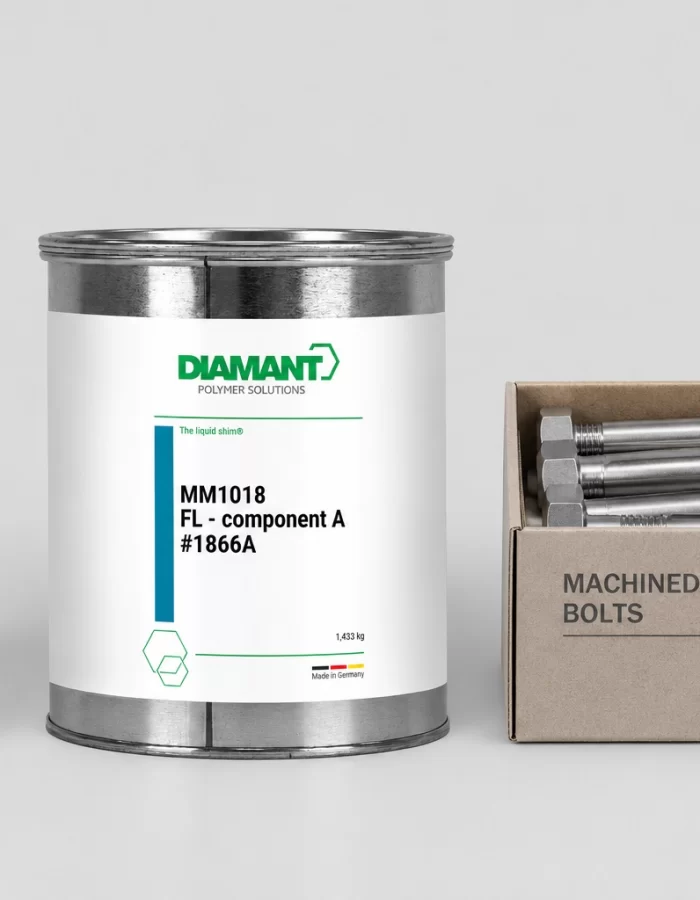
Kubri Engineered Solutions supplies DIAMANT MM1018 and the engineering support to specify it correctly where fitted bolts are either cost-prohibitive or impractical to execute.
Technical Data
MM1018 Injection Screws vs. Machined Fitted Bolts
| Property | MM1018 Injection Resin | Machined Fitted Bolts |
|---|---|---|
| Slip resistance mechanism | Two-component resin injected to fill the clearance between bolt shank and hole wall, forming a full bearing surface once cured | Bolt shank machined to match a hole drilled and reamed to a tight tolerance, eliminating clearance directly |
| Hole preparation | Standard clearance holes; no machining or reaming required | Requires precision drilling and reaming to a tight tolerance for every hole |
| Installation method | Field-injected resin through a small hole in the bolt head, using standard bolts already in place | Drill-and-ream performed on site or in a fabrication shop before bolt installation |
| Cost driver | Uses standard bolts and standard clearance holes; no machining cost | Requires machined holes and precision-fitted bolts, which is significantly more labour- and equipment-intensive |
| Retrofit and strengthening suitability |
Applies to existing connections without modifying the original detail or requiring hole re-machining | Impractical on existing assets, since reaming holes accurately on site is difficult and disruptive. |
All MM1018 figures above are sourced directly from the official DIAMANT Technical Datasheet (#1866, Version 1.1, dated 14 July 2026).
Injection bolt and fitted bolt characteristics are sourced from EN 1993-1-8 and EN 1090-2, consistent with AS 4100 (Connections).
Fatigue certification
DIAMANT MM1018 Fatigue
and Slip Performance
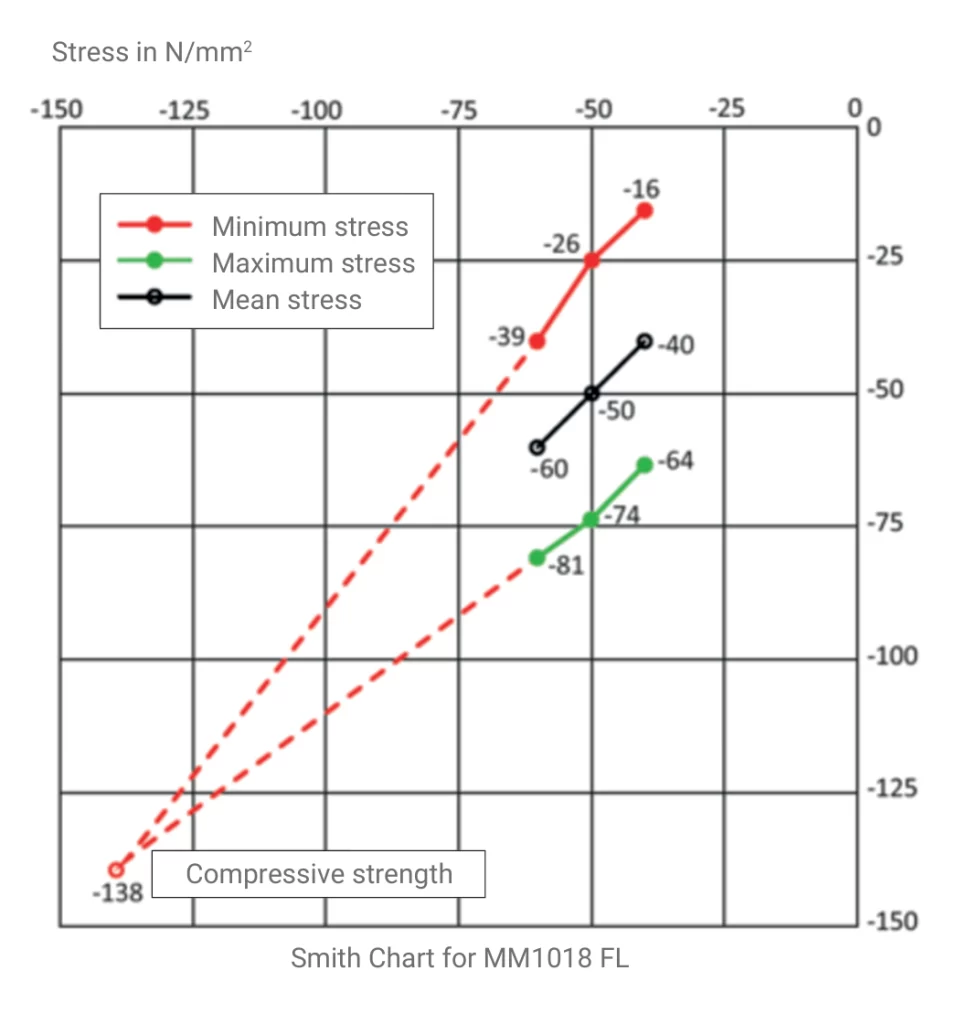
DIAMANT MM1018 has an independently verified fatigue record: 10 million load cycles at ibac RWTH Aachen (test M1999), sustained without cracking or degradation, at mean stresses of 40, 50, and 60 N/mm². For context, EN 1993-1-9 sets the constant-amplitude fatigue limit for structural steel at 5 million cycles.
MM1018’s friction performance has also been independently tested: DIN EN 1090-2 Attachment G testing yielded a friction coefficient of μ = 0.46, comparable to that of a Class B faying surface. Independent research at TU Dortmund University (IGF project 21369 N, published at the IABSE Congress in Ghent 2025) further substantiates the slip reduction and bearing engagement achieved by the cured injection connection.
Together, the fatigue and slip-resistance data support the use of MM1018 injection as a like-for-like alternative to a machined-fitted bolt in cyclically loaded, slip-critical connections.
Application Guide
When to Specify Which
Standard Scenarios for Machined Fitted Bolts
Machined fitted bolts remain the appropriate specification for:
- New-build precision fabrication: Where holes can be drilled and reamed to tolerance in a controlled shop environment before installation.
- Connections requiring zero clearance by design: Where the design basis specifically calls for a mechanically fitted, zero-tolerance shank-to-hole connection.
- Projects where machining cost is not the constraint: Where budget and program allow for the precision drilling and reaming process without schedule pressure.
High-Demand Scenarios for MM1018 Injection Bolts
MM1018 injection is specified over machined fitted bolts in the following cases:
- Retrofit and Strengthening of Existing Structures: Where re-machining holes on an existing asset is disruptive or prohibitively expensive.
- Wind Turbine Tower Connections: Bolted flange joints subject to cyclic wind and rotor loading, where MM1018's documented fatigue performance is directly relevant.
- Crane Girder Connections: Repeated wheel-load cycling on bolted joints benefits from a slip-resistant connection without the cost of machining every hole.
- Bridge Splices and Repairs: Historic and existing bridge steelwork where drilling and reaming original holes to a tight tolerance isn’t practical.
Frequently Asked Questions
An injection bolt is a standard bolt installed in a clearance hole, where the gap between the bolt shank and the hole wall is filled with a two-component resin injected through a small hole in the bolt head.
A small hole is drilled in the bolt head, and resin is injected through it to fill the clearance between the bolt shank and the hole wall, with air escaping through a vent channel in the washer beneath. Chamfered washers are fitted above and below the connection to distribute the resin evenly around the shank. Once the resin cures, the connection is slip-resistant.
No. An injection bolt achieves slip resistance through the cured resin filling the clearance instead, so no preload is required, per EN 1993-1-8. Bolts are still tightened to a standard snug-tight condition as part of normal installation.
Injection bolts typically reuse the existing bolt holes without re-drilling or reaming, which is why the method is common in bridge and heritage steelwork retrofits.

Engineering Authority,
Australian Support.
Specifying MM1018 as an injection resin for a slip-critical bolted connection requires the correct washer detailing, injection sequencing, and cure verification. Getting these details right is what makes the connection perform as designed.
Helping you manage that specification is Kubri Engineered Solutions, Australia’s dedicated technical authority for liquid shim technology.
Kubri Engineered Solutions is the Australian partner for DIAMANT Polymer GmbH, manufacturer of MM1018 The Liquid-Shim®, and holds exclusive technical partnerships with globally recognised manufacturers, including Maurer (expansion joints, structural bearings), Panacor (noise barriers, fire protection walls), and EarthTec (reinforced retaining walls).
KES supports your specification by supplying a complete engineering support package:
Design Support:
Interface review and product-variant selection (FL, P, or Smart S) matched to the gap geometry.
Installation Methodology:
Preparation of method statements covering sealing, injection layout, and QA checkpoints.
Interface Control:
Specification of the complete system, including MM1018 SEAL and dedicated injection hardware
Documentation:
Provision of material certification, batch traceability, and abZ approval documentation formatted for ITPs and asset registers.
Founded by Loai Shokry, a Chartered Professional Engineer (CPEng) with a career spanning the design and delivery of multi-billion-dollar infrastructure projects in Australia and worldwide, Kubri Engineered Solutions is a specification and engineering partner, not just a product distributor.
For a full technical overview of liquid shim technology and applications,
visit the Liquid Shim Australia resource centre.
Talk to a KES engineer
Send us your connection details. A KES engineer will respond within one business day with the correct product selection and the next steps on installation methodology. Final product selection and specification remain subject to engineer-of-record approval for your project.